
The evolution of Coffee - from the first wave to the fourth wave
A practical guide to coffee culture, specialty coffee, technology and choosing the right coffee program for your restaurant or café
What started as a commodity became café culture. Café culture evolved into specialty coffee. And today, technology, automation and process control are changing how coffee is produced and served.
For a restaurant owner, hotel, QSR operator or new café brand, it can help answer a much more practical question:
What kind of coffee program should my business actually have?
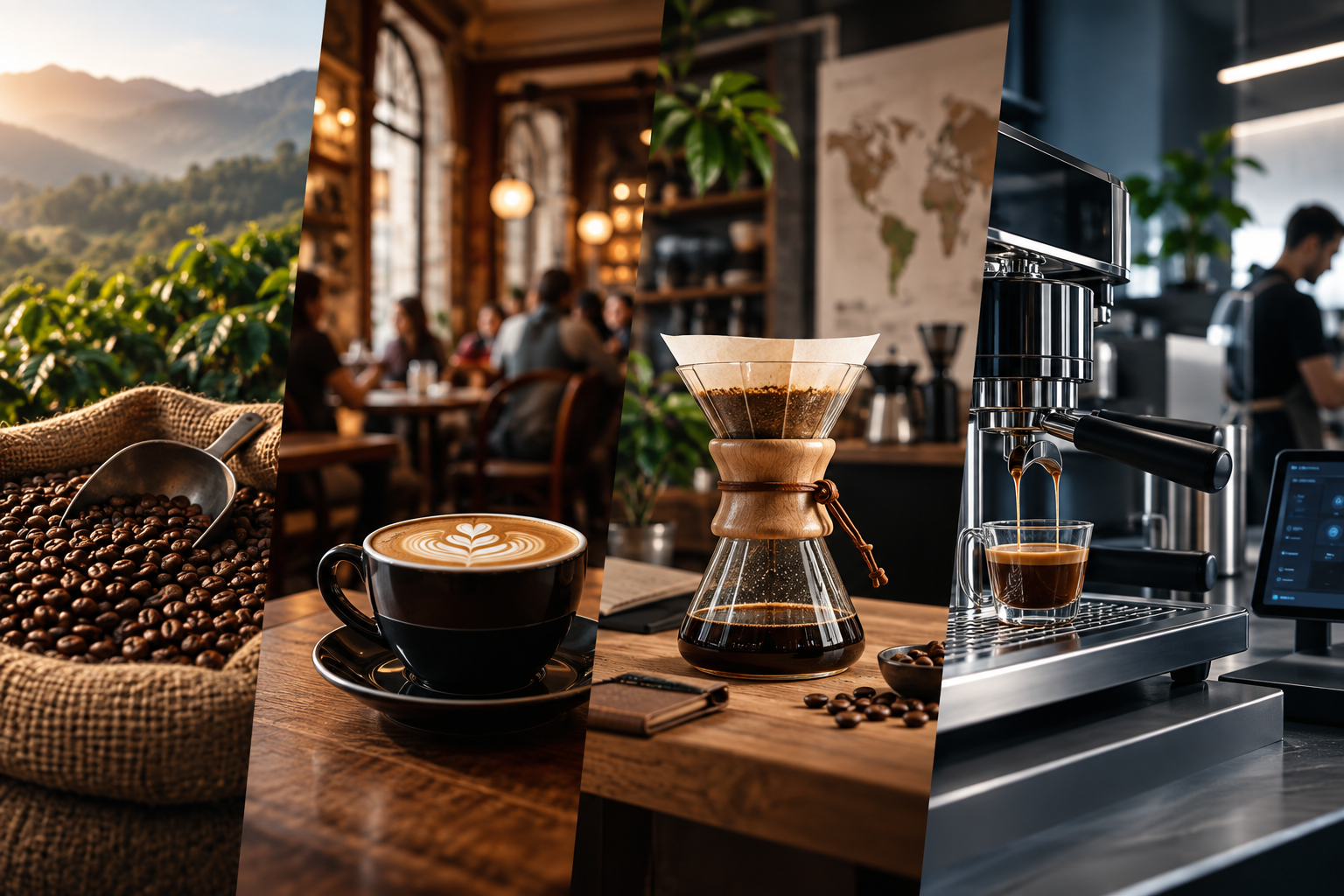
The Four Waves of Coffee
The term “waves” is a useful framework for understanding how coffee culture and the coffee business have evolved.
It isn’t an official industry classification, and different coffee professionals may define the waves differently.
However, the progression provides a useful way to understand the changing role of coffee.
1st Wave: Coffee as a Commodity
The first wave was about availability and convenience.
Coffee became a mass-market product. Instant coffee, packaged ground coffee and home brewing made coffee accessible to millions of consumers.
The objective was simple:
Make coffee available to everyone.
At this stage, coffee was primarily a commodity.
Consumers generally cared more about price, convenience and familiarity than the origin of the bean, processing method or extraction technique.
2nd Wave: Coffee as an Experience
The second wave changed the role of the café.
Coffee became associated with lifestyle, social interaction and hospitality.
Espresso-based beverages such as cappuccino, latte and mocha became mainstream. Café chains created environments where people could meet, work, socialise or simply spend time.
The proposition became:
Don’t just sell coffee. Sell the café experience.
The barista became more visible, café design became increasingly important and coffee became part of a broader lifestyle proposition.
3rd Wave: Coffee as Craft
The third wave shifted attention back towards the coffee itself.
Consumers and professionals became increasingly interested in:
- Bean origin
- Farms and producers
- Terroir
- Processing methods
- Roast profiles
- Freshness
- Brewing techniques
- Extraction
- Water quality
- Traceability
Coffee increasingly began to be treated like wine.
The proposition became:
Understand the coffee. Respect the producer. Control the process.
This is where specialty coffee culture became significantly more influential.
The barista became a craft professional, while grinders, espresso machines and brewing equipment became increasingly sophisticated.
4th Wave: Coffee Meets Science and Technology
The fourth wave takes many of the principles of specialty coffee and combines them with science, technology, automation and process control.
The objective is no longer simply to produce an exceptional cup.
It is to produce it consistently, efficiently and at scale.
A useful way to think about the fourth wave is:
Using technology and scientific understanding to make high-quality coffee more consistent, measurable and scalable.
This can involve:
- Advanced espresso machines
- Precision grinders
- Automated dosing
- Automated tamping
- Recipe management
- Brew control
- Water treatment
- Extraction monitoring
- Super-automatic machines
- Digital ordering
- Workflow optimisation
- Equipment and performance data
The barista is still important.
But the system around the barista becomes increasingly important too.
What Does the 4th Wave Mean for a Restaurant Owner?
This is where the evolution of coffee becomes particularly relevant to restaurant development.
If you’re opening a café today, you don’t necessarily need to build a traditional specialty coffee bar.
The right coffee program depends on your:
Concept + Customer + Menu + Volume + Service Model + Labour + Economics
A premium specialty café may need:
High-end espresso machine + premium grinders + skilled baristas + specialty beans + manual brewing
A high-volume QSR may need:
Speed + consistency + automation + simplified recipes + high throughput
A restaurant may simply need:
A reliable espresso program that supports breakfast, desserts and after-meal coffee
A hotel may require:
Multiple coffee formats across restaurants, banquets, room service and lobby operations
A health-focused café may need:
Coffee + functional beverages + smoothies + cold beverages + grab-and-go
There is no universally correct coffee setup.
How Do You Choose the Right Coffee Program?
Before selecting an espresso machine, start with the business.
1. Who is the customer?
Are they serious coffee enthusiasts, regular café customers or primarily looking for a good beverage alongside food?
2. What is the expected volume?
A low-volume specialty café has very different equipment requirements from a high-volume QSR processing hundreds of beverages during peak periods.
3. How much labour can the concept support?
A coffee program dependent on highly trained baristas has a different operating model from one designed around automation.
4. What is the role of coffee in the concept?
Is coffee:
- The hero product?
- A major revenue stream?
- A supporting category?
- An accompaniment to food?
5. What is the service model?
Dine-in, takeaway, delivery, kiosk, drive-through and hybrid models all create different workflow requirements.
6. What level of consistency is required?
The more stores a brand operates, the more important recipe standardisation, training and process control become.
7. What are the economics?
Coffee equipment shouldn’t be evaluated on purchase price alone.
Consider:
CAPEX + Labour + COGS + Maintenance + Throughput + Revenue Potential
A ₹10 lakh machine isn’t automatically a better investment for a business than a ₹3 lakh machine.
The question is whether the additional investment creates enough operational or commercial value.
Espresso Machine vs Super-Automatic
One of the most important decisions for a modern coffee concept is whether to build around a traditional espresso setup or a super-automatic system.
Traditional Espresso Machine
Typically offers:
- Greater barista control
- More flexibility
- Strong specialty-coffee positioning
- Greater scope for customisation
- Higher dependence on training and execution
Super-Automatic Machine
Typically offers:
- Greater consistency
- Faster service
- Reduced dependence on barista skill
- Simplified training
- Potentially higher operational efficiency
Neither is automatically the right answer.
The correct choice depends on the business model, volume, menu and customer expectation.
Coffee Equipment Should Follow the Operating Model
One of the common mistakes in café development is choosing equipment before defining the operating model.
The process should work in the opposite direction.
Concept → Customer → Menu → Volume → Service Model → Workflow → Labour → Equipment
Not:
Machine → Coffee Menu → Figure Out Operations Later
The equipment should serve the business.
Not the other way around.
Does Every Café Need Specialty Coffee?
No.
This is an important distinction for new operators.
A specialty coffee program can add product differentiation and credibility, but it also comes with additional requirements around sourcing, equipment, training, quality control and customer education.
For some concepts, that investment makes strategic sense.
For others, a simpler and more operationally efficient coffee program may be more appropriate.
The question shouldn’t be:
“Should we do specialty coffee?”
It should be:
“What level of coffee program does our customer and business model justify?”
The 4th Wave and the Future of Coffee
The fourth wave is still evolving.
Technology is making coffee increasingly measurable, automated and repeatable.
But the important change isn’t simply the introduction of better machines.
It is the growing ability to design the entire coffee operation as a system.
That means looking at:
Product → Equipment → Workflow → Labour → Training → Supply Chain → Unit Economics → Scalability
For restaurant and café operators, this is perhaps the most useful lesson from the evolution of coffee.
You don’t need to build the most sophisticated coffee program.
You need to build the right coffee program for your business.
Frequently Asked Questions About Coffee Waves
What are the four waves of coffee?
The four waves are commonly used to describe the evolution of the coffee industry:
1st Wave: Coffee as a commodity and mass-market product.
2nd Wave: Coffee as a café experience and lifestyle.
3rd Wave: Coffee as craft, with greater emphasis on specialty coffee, origin and preparation.
4th Wave: Coffee combined with science, technology, automation and process control.
The terminology is not an official industry classification and definitions vary.
What is the 4th wave of coffee?
The fourth wave refers to the increasing use of technology, science, automation and process control to improve coffee quality, consistency, efficiency and scalability.
Is specialty coffee the same as third-wave coffee?
Not exactly.
Specialty coffee refers primarily to a quality-oriented approach to coffee, while “third wave” describes a broader movement focused on provenance, craft, preparation and appreciation of coffee.
Is the 4th wave of coffee about automation?
Automation is an important part of the fourth wave, but it is broader than automation alone.
It also includes precision, process control, data, equipment technology and the ability to produce consistent coffee at scale.
What coffee machine should a new café buy?
There is no universal answer.
The machine should be selected based on expected volume, menu, customer profile, service model, labour availability, barista skill, workflow, budget and desired level of automation.
Should a café use a traditional espresso machine or a super-automatic?
A traditional espresso machine generally provides greater barista control and flexibility.
A super-automatic machine can simplify training and improve consistency and speed.
The appropriate choice depends on the café’s operating model.
Does a restaurant need a specialty coffee program?
Not necessarily.
The appropriate coffee program depends on the role coffee plays within the concept.
A specialty café may require a significantly more sophisticated program than a restaurant where coffee is primarily an accompaniment to food.
How much should a café invest in coffee equipment?
Equipment investment should be evaluated against expected sales, throughput, labour requirements, maintenance, product quality and return on investment rather than machine price alone.
What equipment does a specialty coffee shop need?
A typical specialty coffee setup may include:
- Espresso machine
- One or more grinders
- Water filtration
- Scales
- Brewing equipment
- Refrigeration
- Ice equipment
- Bar tools
- Storage and supporting equipment
The exact setup depends on the menu and operating model.
How do I choose a coffee program for my restaurant?
Start with the concept rather than the equipment.
Define the customer, menu, expected volume, service model, labour model and economics first.
Then determine the appropriate coffee equipment, workflow and training requirements.
The Project X Perspective
Coffee has evolved from a commodity into a highly sophisticated product category.
But for a restaurant or café operator, the most important question isn’t:
“Which coffee machine is the best?”
It is:
“What coffee system makes sense for my business?”
At Project X Restaurants, we look at coffee as part of the larger operating model — connecting the product to the concept, customer, menu, equipment, layout, labour, training, throughput and economics.
Because good coffee is a product decision.
A good coffee program is a business decision.
About the Author
Ashwani Basantani is the Founder of Project X Restaurants, a restaurant consulting firm working with cafés, QSRs, restaurants and food businesses across concept development, design, kitchen planning, menu development, operations, recruitment, training and scale-readiness.
His work focuses on helping food businesses build the right fundamentals before they scale.
Ashwani Basantani
Founder & Principal Consultant
Project X Restaurants