
How Much Does It Really Cost to Open a Restaurant in India in 2026?
How much does it cost to open a restaurant in India?
It is one of the first questions almost every restaurant founder, investor or entrepreneur asks.
The problem is that there is no single answer.
A 500 sq. ft. QSR, a 1,500 sq. ft. café, a 3,000 sq. ft. casual dining restaurant and a 5,000 sq. ft. premium restaurant can have completely different investment requirements.
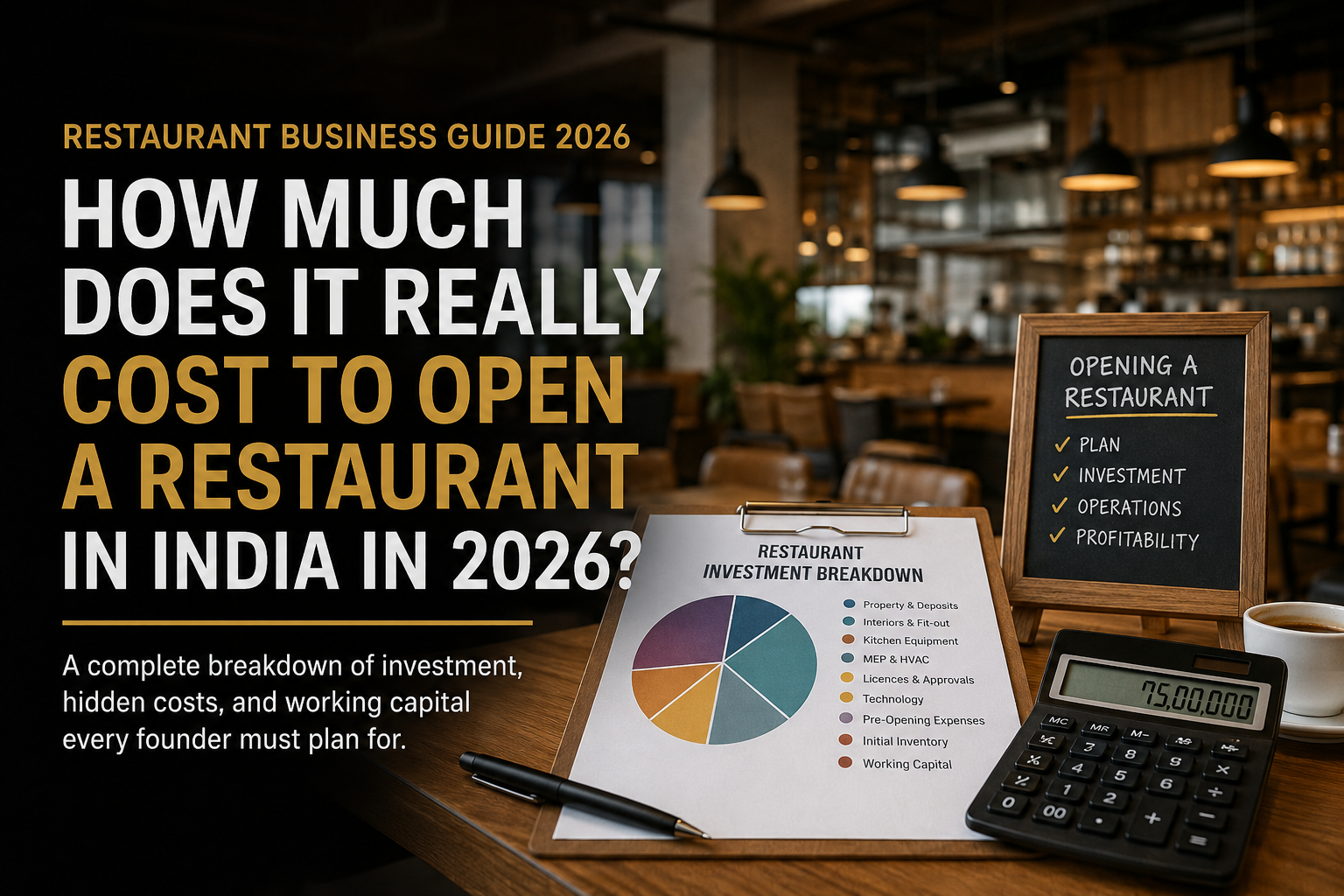
More importantly, the cost of building a restaurant is not the same as the amount of capital required to successfully launch and stabilise the business.
A founder may budget ₹50 lakh for a new restaurant and discover that the actual cash requirement is closer to ₹70–80 lakh once security deposits, fit-out, kitchen equipment, licences, recruitment, pre-opening expenses, initial inventory and working capital are included.
At Project X Restaurants, we approach restaurant investment as a complete business and operating model rather than simply an interior and construction exercise.
The Three Numbers Every Restaurant Founder Should Know
Before calculating the cost of a restaurant, it is important to distinguish between three different numbers.
1. Project Cost
This is the capital required to physically build the restaurant.
It generally includes design, civil work, interiors, MEP, HVAC, kitchen equipment, furniture, signage, technology and other construction-related expenses.
2. Opening Cash Requirement
This includes the project cost plus the expenditure required to get the restaurant operational.
It can include security deposits, advance rent, initial inventory, packaging, recruitment, training, pre-opening payroll and launch marketing.
3. Total Capital Required
This is the most important number.
It includes the opening investment plus sufficient working capital to support the business during its ramp-up period.
A restaurant can open successfully and still fail because the founder runs out of cash three or four months later.
How Much Does It Cost to Open Different Types of Restaurants in India?
There is no universal cost, but the following can be used as a broad 2026 planning framework.
| Restaurant Format | Typical Size | Broad Initial Investment |
|---|---|---|
| Delivery-focused QSR / cloud kitchen | 300–700 sq. ft. | ₹15–35 lakh |
| Small QSR / takeaway | 400–900 sq. ft. | ₹25–50 lakh |
| Café | 800–1,500 sq. ft. | ₹40–80 lakh |
| Premium café | 1,200–2,000 sq. ft. | ₹60 lakh–₹1.2 crore |
| Casual dining | 1,500–3,000 sq. ft. | ₹75 lakh–₹1.5 crore+ |
| Premium restaurant | 2,500–5,000+ sq. ft. | ₹1.5–3 crore+ |
These are planning ranges, not quotations.
The final investment can vary substantially depending on the city, location, property condition, rent, concept, menu, kitchen specification, design standards, service model and working-capital requirement.
1. Property and Security Deposit
One of the largest initial cash requirements is often the property itself.
Depending on the landlord and location, the project may require:
- Security deposit
- Advance rent
- Brokerage
- Legal expenses
- Rent during the fit-out period
- Common Area Maintenance (CAM)
- Electricity deposits
- Other landlord charges
This is why a property should never be evaluated purely on its monthly rent.
A property with a slightly higher rent may actually be more commercially attractive if it has better visibility, stronger sales potential, lower fit-out requirements or a more favourable commercial structure.
The correct calculation is:
Rent + deposit + CAM + fit-out period + revenue potential + occupancy cost
2. Design and Professional Fees
A restaurant requires much more than an interior designer.
Depending on the project, professional consultants can include architects, interior designers, kitchen consultants, MEP consultants, HVAC consultants, fire consultants, lighting specialists and project-management teams.
The design process should not begin with:
“How should the restaurant look?”
It should begin with:
“How should the restaurant operate?”
The design needs to accommodate customer movement, kitchen workflow, receiving, storage, preparation, cooking, plating, dispatch, dishwashing, waste movement, staff movement, HVAC, electrical requirements, plumbing and fire safety.
A visually impressive restaurant with an inefficient kitchen can become an expensive operational problem.
3. Civil Work and Interiors
Civil and interior work is where restaurant budgets can start expanding rapidly.
Typical expenditure can include flooring, wall finishes, ceilings, partitions, counters, joinery, furniture, lighting, washrooms, façade treatment, signage and decorative elements.
The condition of the property makes a major difference.
A previously operational restaurant with usable MEP infrastructure can require substantially less investment than a bare-shell property.
This is why property technical due diligence should happen before signing the lease, rather than after.
4. Commercial Kitchen Equipment
The kitchen is one of the most important capital investments in a restaurant.
Depending on the concept and menu, equipment may include:
- Cooking ranges
- Fryers
- Grills
- Ovens
- Combi ovens
- Salamanders
- Refrigerators
- Freezers
- Blast chillers
- Prep counters
- Bain-marie
- Dishwashers
- Ice machines
- Food processors
- Mixers
- Planetary mixers
- Sinks
- Racking
- Exhaust systems
- Grease management systems
The kitchen equipment list should be developed from the menu and production process.
Not the other way around.
If a concept relies heavily on baking, roasting, frying, chilling, batch production or centralised preparation, the equipment strategy must reflect those processes.
Buying equipment first and then trying to fit the menu around it is one of the fastest ways to create an inefficient kitchen.
5. HVAC, Exhaust and MEP
Restaurant MEP is another area where initial budgets are frequently underestimated.
Electrical
The electrical scope can include connected load calculations, panels, cabling, distribution boards and equipment-specific electrical infrastructure.
HVAC
Depending on the restaurant, this can include air conditioning, fresh air, kitchen exhaust, make-up air and ducting.
Plumbing
Water supply, drainage, grease management, hot water and wastewater systems all need to be considered.
Fire and Safety
Fire-fighting systems, detection systems, emergency infrastructure and fire-rated construction may also form part of the project.
The exact requirement depends on the property and local regulations.
A property that cannot technically support the restaurant’s required HVAC, exhaust, electrical or fire infrastructure can turn into a major financial problem after the lease has already been signed.
6. Licences and Statutory Approvals
Restaurant licensing requirements vary by city, state, property and business model.
Depending on the project, requirements may relate to:
- FSSAI
- GST
- Shops and Establishments
- Fire safety
- Municipal permissions
- Signage
- Music
- Liquor, where applicable
- Weights and measures
- Waste management
- Other local regulatory requirements
There is therefore no sensible universal number for “licence cost.”
A proper restaurant feasibility exercise should create a location-specific compliance checklist before the project is committed.
7. Technology
A modern restaurant also requires an operating technology stack.
Depending on the format, this may include:
- POS
- Kitchen Display System (KDS)
- Inventory management
- Recipe management
- Procurement systems
- CRM
- Loyalty
- Digital menus
- CCTV
- Wi-Fi
- Payment systems
- Delivery integrations
- Management reporting
For a single outlet, technology may represent a relatively small portion of the overall investment.
For a multi-unit business, however, technology becomes an important part of operational control.
The owner should eventually be able to monitor sales, food cost, discounts, labour, wastage, inventory variance and store-level profitability without physically being present at the outlet.
8. Pre-Opening Expenses
A restaurant starts spending money well before it starts generating meaningful revenue.
Pre-opening expenses can include recruitment, salaries during training, uniforms, staff meals, menu trials, product development, photography, branding, packaging, marketing, trial production, cleaning and launch activities.
These expenses are often missing from the first version of a restaurant budget.
They shouldn’t be.
If the restaurant requires four weeks of recruitment, training, trials and pre-opening preparation, those four weeks represent real cash expenditure.
9. Initial Inventory
A restaurant needs stock before it generates sales.
This can include food ingredients, beverages, packaging, cleaning materials, disposables and other operating supplies.
The correct inventory level depends on:
- Supplier lead times
- Minimum order quantities
- Shelf life
- Storage capacity
- Delivery frequency
- Product availability
Overstocking ties up working capital.
Understocking creates operational problems.
The objective is to design an inventory model that balances availability, freshness, storage space and cash efficiency.
10. Working Capital: The Cost Founders Forget
This is arguably the most underestimated component of restaurant investment.
A restaurant does not become financially stable on the day it opens.
During the first few months, the business may experience:
- Lower-than-target sales
- Higher wastage
- Labour inefficiency
- Higher marketing expenditure
- Product development
- Discounting
- Staff turnover
- Inventory inefficiencies
- Operational corrections
The business therefore needs a working-capital buffer.
A simple planning approach is:
Working Capital Requirement = Monthly Cash Burn × Expected Ramp-Up Period
If the restaurant is expected to take four to six months to reach its target operating performance, the founder needs sufficient liquidity to support that period.
This is why a restaurant that costs ₹60 lakh to build may actually require ₹75–90 lakh of available capital.
The difference is not necessarily overspending.
It may simply be the capital required to reach stable operations.
11. Space Efficiency Is a Financial Decision
Restaurant real estate is expensive.
Every square foot needs to justify its existence.
Consider a 2,000 sq. ft. restaurant.
The space may need to accommodate dining, kitchen, storage, washrooms, circulation, back-of-house and dispatch.
If too much space is allocated to low-productivity areas, the restaurant carries additional occupancy cost without generating proportional revenue.
This is why restaurant planning needs to consider:
Revenue per square foot
and
Throughput per square foot
The same principle applies to the kitchen.
A kitchen that is unnecessarily large increases construction and occupancy costs.
A kitchen that is too small restricts throughput.
Good restaurant planning is therefore about efficient allocation of space, not simply making the restaurant look bigger.
12. Why Restaurant Budgets Go Wrong
Most restaurant budget overruns do not come from one enormous mistake.
They usually come from dozens of smaller decisions.
A better finish here.
More expensive furniture there.
Additional lighting.
A larger sign.
An imported piece of equipment.
Another refrigerator.
A revised kitchen.
Additional civil work.
A delayed opening.
Another month of rent.
Additional payroll.
Each decision may appear manageable individually.
Together, they can add ₹10–20 lakh—or substantially more—to a project.
The solution is not simply to “control costs.”
The solution is to establish a capex framework before design and procurement begin.
Every major expenditure should answer a simple question:
Does this improve revenue, throughput, efficiency, customer experience, compliance or long-term asset value?
If the answer is no, it deserves scrutiny.
13. Build the Budget Backwards From the Business Model
A restaurant budget should not begin with:
“We have ₹1 crore to spend.”
It should begin with:
“What financial model does this restaurant need to achieve?”
For example, suppose the target is ₹35 lakh in monthly sales with defined food-cost, labour, occupancy and operating-cost assumptions.
The proposed investment should then be tested against the expected return.
This allows the founder to evaluate whether the proposed:
- Rent
- Size
- Kitchen
- Equipment
- Interiors
- Staffing model
are economically justified.
A ₹1.2 crore restaurant may be completely reasonable for one concept and financially irrational for another.
A Better Restaurant Feasibility Framework
Before committing capital, a restaurant project should be evaluated across five interconnected layers.
Market
Catchment, customer profile, competition, accessibility, demand and sales potential.
Concept
Format, menu, price point, service model and brand proposition.
Operations
Kitchen, equipment, labour, supply chain, storage and throughput.
Financials
Capex, rent, revenue, food cost, labour, EBITDA, break-even and working capital.
Risk
Construction overruns, delayed opening, lower-than-expected sales, food-cost inflation, staffing issues, vendor dependency and regulatory constraints.
The project becomes investable only when these five layers work together.
So, How Much Should You Budget?
As a broad planning framework for India in 2026:
Small QSR: ₹25–50 lakh
Café: ₹40–80 lakh
Premium café: ₹60 lakh–₹1.2 crore
Casual dining restaurant: ₹75 lakh–₹1.5 crore+
Premium restaurant: ₹1.5–3 crore+
These numbers should never be treated as a final project budget.
The actual investment depends on:
Location + area + concept + menu + kitchen + design specification + rent + property condition + service model + expected sales + working capital
A restaurant should be financially engineered, not simply budgeted.
The Biggest Mistake: Starting Construction Before Building the Financial Model
One of the most expensive mistakes we see is following this sequence:
Lease → Design → Contractor → Construction → Kitchen → Launch → Then calculate whether the business works.
A better sequence is:
Market → Concept → Menu → Unit Economics → Location → Feasibility → Space Planning → Design → BOQ → Vendor Procurement → Construction → Hiring → Training → Launch
The difference is significant.
The first approach builds a restaurant.
The second builds a business.
Final Takeaway
There is no fixed cost to open a restaurant in India in 2026.
A small QSR may be launched for a few tens of lakhs, while a premium restaurant can require several crores.
But the most important number is not the cost of the interiors or kitchen.
It is the total capital required to reach a stable, profitable operating position.
That includes the property, fit-out, equipment, MEP, licences, technology, recruitment, training, launch expenses, initial inventory and—most importantly—working capital.
If the financial model does not work on paper, spending more money on the restaurant will not fix it.
The objective is not to build the most expensive restaurant possible.
The objective is to build the most commercially viable restaurant that can deliver the intended customer experience.
Frequently Asked Questions
How much does it cost to open a restaurant in India in 2026?
The investment varies significantly by format. A small QSR may require approximately ₹25–50 lakh, a café around ₹40–80 lakh, a casual dining restaurant around ₹75 lakh–₹1.5 crore and a premium restaurant ₹1.5 crore or more.
Is ₹50 lakh enough to open a restaurant?
It can be sufficient for certain small-format QSRs, cafés or takeaway concepts, particularly where the property and operating model are efficient. It may not be sufficient for a large-format restaurant, premium café or high-capex concept.
What is the biggest expense when opening a restaurant?
There is no single biggest expense across all formats. Property-related costs, civil and interiors, kitchen equipment, HVAC/MEP and working capital can each represent significant portions of the investment.
How much working capital does a new restaurant need?
It depends on the restaurant’s monthly cash burn and expected ramp-up period. The business should maintain sufficient liquidity to cover its operating requirements until sales reach the level assumed in the feasibility model.
Should I spend more on interiors or kitchen equipment?
The answer depends on the concept. Customer-facing investment should support the brand proposition, while kitchen investment should support the menu, throughput, food quality and operational efficiency.
Should I open a restaurant in a high-rent location?
Not necessarily. A high-rent location can work when the additional revenue potential justifies the higher occupancy cost. Location should be evaluated through sales potential and unit economics rather than prestige alone.
About the Author
Ashwani Basantani is the Founder of Project X Restaurants, a restaurant consulting and F&B strategy firm focused on helping founders, operators and investors build, restructure and scale food businesses.
His work spans restaurant concept development, market and location strategy, menu engineering, unit economics, kitchen and operational planning, supply-chain design, central kitchens, restaurant setup, recruitment, restructuring and multi-unit growth.
Through Project X Restaurants, Ashwani has worked across different food and beverage formats, including QSRs, cafés, premium restaurants, delivery businesses and emerging food brands.
His approach combines commercial strategy with on-ground restaurant execution, with a particular focus on capital efficiency, operational systems, throughput, scalability and long-term business fundamentals.
Connect with Ashwani Basantani on LinkedIn:
[www.linkedin.com/in/ashwanibasantani]
Project X Restaurants
Restaurant Consulting | F&B Strategy | Restaurant Setup | Operations | Growth & Scale