
THE FINAL ZIKR - Turning the ritual of dum biryani into a modern food-court experience
PROJECT SNAPSHOT
Zikr was built around a simple question:
What if the most exciting part of eating biryani happened right in front of the customer?
Project X Restaurants developed Zikr as a contemporary Hyderabadi dum biryani concept for a food-court environment — combining an authentic cooking ritual with a compact, high-visibility QSR format.
The result was a brand where the product, equipment, counter and customer experience all revolve around one thing: the dum.
The challenge
Biryani was a commodity and everyone right, left and centre was selling it
THE BRIEF
Build a biryani brand that could stand out without trying to reinvent biryani.
Biryani is already one of India’s most familiar food categories.
The challenge was therefore not creating another biryani menu.
It was creating a reason to choose Zikr.
The concept needed to:
- Work within a compact food-court format
- Have a clear and instantly understandable proposition
- Retain the authenticity associated with dum biryani
- Create visual theatre without compromising operations
- Make the cooking process part of the customer experience
- Be commercially accessible rather than positioned as a fine-dining product
- Have the potential to become a recognisable, scalable QSR format
The answer came from looking at the product itself.
The Project X approach
The best part of dum biryani happens before you eat it.
There is something inherently theatrical about dum cooking.
The handi is sealed.
The rice and meat cook together.
The aromas build.
And then comes the moment when the seal is opened and the steam escapes.
That moment creates anticipation.
Project X decided to make that moment the brand.
Instead of hiding the dum process behind the kitchen, Zikr would put it where customers could see it.
THE IDEA
THE FINAL ZIKR
Zikr takes the traditional dum ritual and turns it into a contemporary QSR experience.
The customer sees the handi.
They see the cooking.
They see the steam.
And finally, they see the biryani being opened and served.
HANDI → DUM → REVEAL → SERVE
The process itself becomes the theatre.
And that theatre becomes part of the brand.
THE PRODUCT
Authentic dum. Contemporary format.
The hero of Zikr remains what it should be:
Hyderabadi Dum Biryani.
Rather than complicating the proposition with an unnecessarily large menu, the concept was built around making the hero product memorable.
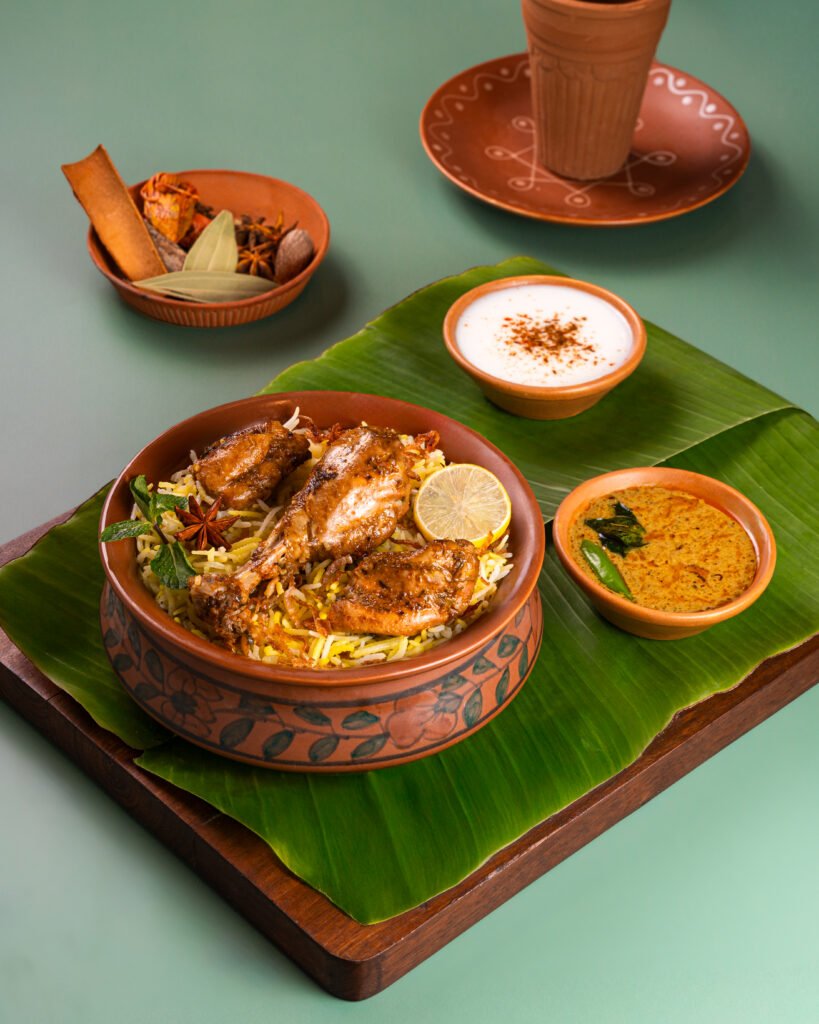
The earthen handi reinforces the traditional cooking language while giving the product a strong visual identity.
The objective was simple:
When customers think of Zikr, they should immediately think of dum biryani.
THE LIVE DUM STATION
Turning a cooking process into a customer experience.
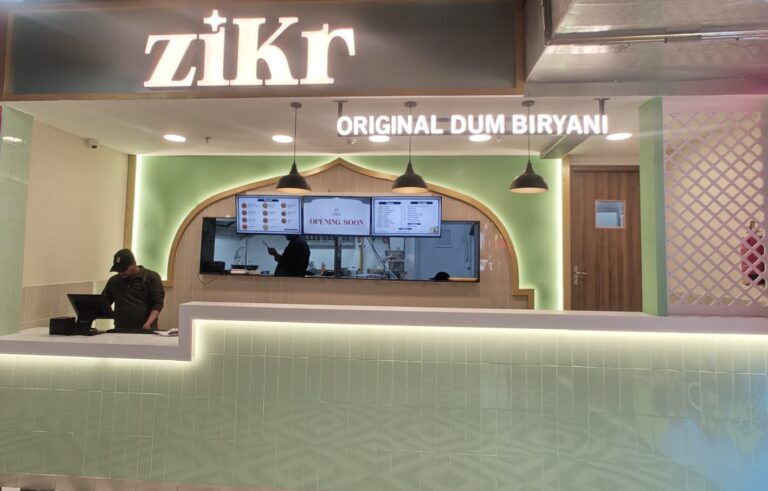
The live dum station became the centrepiece of the concept.
Earthen handis sit directly over controlled heating elements, allowing the dum process to happen within the customer-facing environment.
A glass-covered counter allows the activity to remain visible.
This creates something unusual for a QSR:
The kitchen becomes part of the brand.
The equipment is no longer just a production tool.
It becomes:
Theatre.
Signage.
Product demonstration.
Brand identity.
THE FINAL REVEAL
The moment Zikr is built around.
The experience culminates in the opening of the handi.
Steam escapes.
The aroma hits first.
The biryani is revealed.
And the customer sees the product they have just watched being cooked.
This is the “Final Zikr”.
A simple product ritual becomes a memorable brand moment.
THE FOOD-COURT CHALLENGE
In a food court, attention has to be earned.
A food-court customer is surrounded by competing brands.
There is no guarantee that they will stop at your counter.
Zikr therefore needed to communicate its proposition visually and almost instantly.
The live dum station became the primary attention mechanism.
A passing customer should be able to understand:
Biryani is being cooked here.
It is happening live.
And something interesting is about to be served.
That is a much stronger proposition than another static menu board.
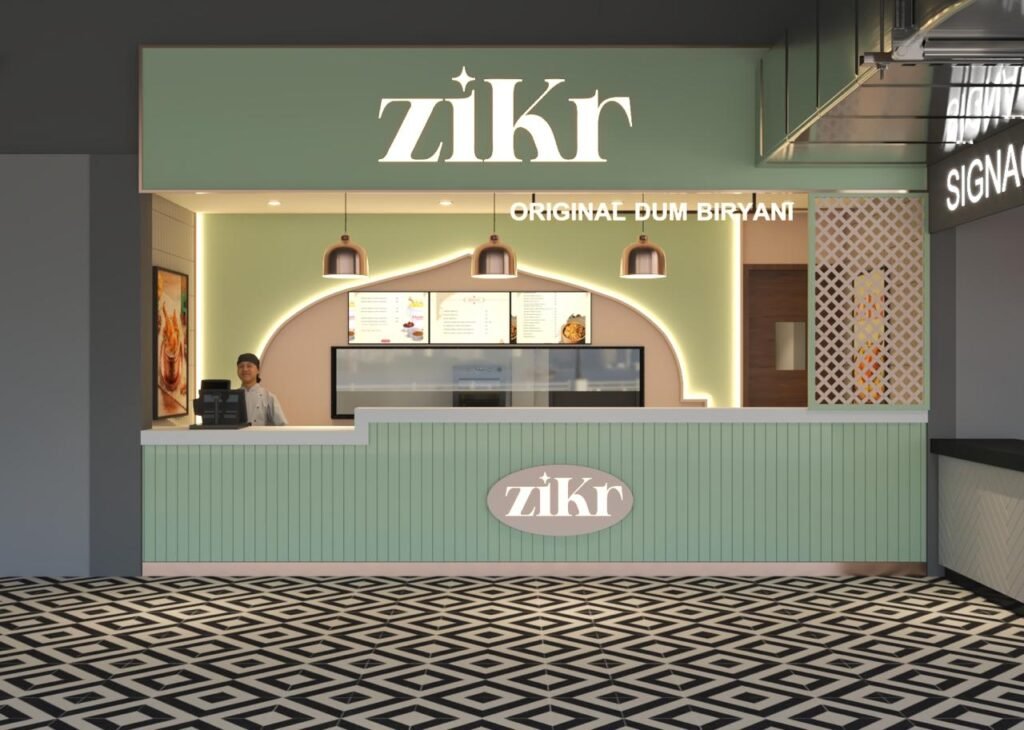
THE COUNTER
Designed around the product, not around decoration.
The Zikr counter was developed as a working piece of theatre.
The live dum setup occupies the visual centre.
The handis create repetition and movement.
The product remains visible.
Communication reinforces the proposition.
And the customer-facing elements are integrated with the operational workflow.
Every visible element has a job.
Attract attention.
Explain the product.
Create appetite.
Support ordering.
Reinforce the brand.
THE TERRACOTTA LANGUAGE
Traditional material. Contemporary presentation.
The use of terracotta and earthen vessels was not treated as decorative nostalgia.
It was directly connected to the product.
The material reinforces:
Dum cooking.
Handi cooking.
Indian culinary heritage.
Heat.
Earth.
Authenticity.
But the overall environment was kept contemporary so that Zikr would feel like a modern QSR rather than a traditional restaurant.
The objective was not to make the brand look old.
It was to make tradition look relevant.
Zikr had to feel young without becoming gimmicky.
The visual language was designed for a contemporary food-court audience.
The brand needed to be:
Accessible
Not intimidating or overly premium.
Visual
Strong enough to attract attention from a distance.
Memorable
Easy to recognise after one visit.
Authentic
Rooted in the product rather than manufactured storytelling.
Scalable
Capable of being translated into multiple locations.
THE COMMUNICATION
Let the product do the talking.
Rather than relying on long explanations, Zikr’s communication was built around short, high-impact cues.
The central idea:
THE FINAL ZIKR
The LED ticker and counter communication could reinforce the movement and anticipation around the live dum process.
The objective was to create a constantly moving visual cue within an otherwise static food-court environment.
See it. Smell it. Want it.
OPERATIONS
Theatre without operational chaos.
The biggest risk with any live-food concept is creating something that looks exciting but becomes difficult to operate.
Project X therefore approached the dum station as both:
Experience design + production system.
The workflow had to account for:
- Preparation
- Portioning
- Dum cooking
- Holding
- Finishing
- Service
- Cleaning
- Staff movement
- Customer visibility
The live experience could not come at the cost of consistency or throughput.
The principle:
Make the process visible without making the operation complicated.
DESIGNING FOR SCALE
A concept should be repeatable, not dependent on one location.
Zikr was conceived as a format rather than a one-off restaurant.
That meant decisions had to work within the realities of a QSR:
- Compact footprint
- Controlled equipment
- Defined production flow
- Clear customer journey
- Repeatable presentation
- Easy-to-understand product proposition
- Consistent brand theatre
The objective was to create a system that could eventually be reproduced across locations without losing the core Zikr experience.
THE RESULT
THE TRANSFORMATION
FROM
Biryani as a product TO
Biryani as an experience
FROM
Dum happening behind the scenes TO
Dum becoming the theatre
FROM
Equipment as back-of-house infrastructure TO
Equipment as brand identity
FROM
A food-court counter TO
A recognisable QSR format
WHAT PROJECT X ACTUALLY CHANGED
THE FINAL ZIKR
The ritual became the reason to stop.
Zikr is ultimately built around a simple idea:
Don’t just serve the biryani.
Let people experience the dum.
Let them see the handi.
Let them see the cooking.
Let them anticipate the reveal.
And then let the product do what it has always done best.
Create the final moment.
PROJECT X RESTAURANTS
We build food businesses around the realities of execution.
Project X Restaurants works with founders, investors and food businesses to develop concepts that are commercially clear, operationally viable and designed for growth.
Our work spans:
Concept Development
Menu & Product Development
Kitchen & Equipment Planning
Restaurant & QSR Consulting
Operations & SOPs
Pre-Opening & Launch
Scale & Format Development
PROJECT X RESTAURANTS
Certainty. Credibility. Knowledge Arbitrage. Execution Capacity.
We help restaurant owners, investors and hospitality businesses build, restructure and scale commercially viable food businesses.
Have a food business that needs to be built properly?
LET’S TALK →